Meme Coin Trading, A Million-Dollar Breakdown
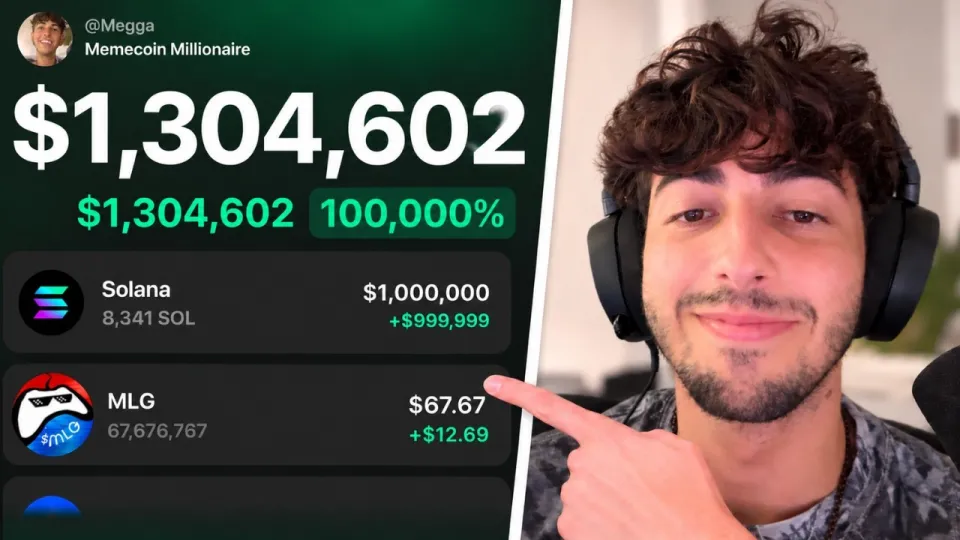
Video: How I Made $1,000,000 Trading Memecoins (FULL BREAKDOWN)
Need articles like this for your video? They help promote it on YouTube and Google — order them in the Telegram bot @sat_sit_bot. It writes articles around your video, embeds the video and publishes them on popular niche websites (no ads). Free trial — 50 articles.
· based on the channel Megga
Key takeaways
- Megga's breakdown describes a $1,000,000 cumulative result from trading meme coins, built over a long grind rather than one lucky trade.
- The video's core message: losses and drawdowns are a normal part of the process, not a sign the strategy is broken.
- Megga offers a free course via Whop and recommends the Padre trading terminal for low fees.
- Meme coins have no cash flow or fundamentals — every dollar of profit comes from another participant's loss.
- Sustained screen time (viewers cite 9–12 hour sessions) is presented as the real edge, not a single 'gem' call.
A meme coin is a cryptocurrency with no cash flow, no product and no fundamentals — its price is driven purely by attention and liquidity. Megga's breakdown of how he made $1,000,000 trading them is not a shortcut map but a record of a long grind: thousands of hours in the "trenches", repeated drawdowns, and a process refined until the wins outweighed the losses. The free course linked in the video is here: Megga's free trading course on Whop.
The most important thing to understand before anything else: in meme coins, profit is transferred, not created. There is no revenue, no earnings, no treasury. When one wallet turns $3,000 into $300,000, that money came out of other buyers' pockets — often the people who bought the top of the same chart. Any honest breakdown of a seven-figure result has to start there.
What a million dollars in meme coin trading actually represents
A $1,000,000 result in meme coins is a cumulative profit-and-loss figure accumulated across many positions, not a single trade. That distinction matters because it changes what you are copying. You are not copying one entry and one exit; you are copying a repeatable loop of research, sizing, entry, exit and review, run hundreds of times.
In practice, the arithmetic of such a result looks unglamorous. A trader might take 300–500 positions over a year, with the majority losing money or breaking even, a handful returning 2x–5x, and one or two returning 20x or more. The skill is not predicting which one is the 20x — it is staying solvent and psychologically intact long enough for the distribution to play out. That is why the traders who survive are obsessive about position sizing and about cutting losers fast rather than about finding the next big ticker.
The mechanics of the trenches: where meme coin trades are found
Meme coin trading happens in a specific environment — launchpads, on-chain scanners, and social feeds where new tokens appear every few minutes. The workflow that experienced traders describe follows a fairly consistent sequence:
- Source flow. Watch launch feeds and social timelines for tokens gaining organic attention, not paid promotion.
- Check the contract. Verify that liquidity is locked or burned, that the deployer wallet is not holding a large share, and that the token cannot be minted or taxed arbitrarily.
- Map the holders. Look for clusters of wallets funded from the same source — a classic sign of insider allocation that will be dumped on retail.
- Size the position. Decide the maximum loss before entering, not after. Many traders risk a fixed small percentage of the bankroll per idea.
- Exit in tranches. Sell a portion into the first spike to recover the initial capital, then let the remainder run with a trailing plan.
- Log the result. Record the thesis, the entry, the exit and what went wrong or right — this is where the actual edge compounds.
Steps 2 and 3 are where most newcomers skip work, and it is exactly where the losses come from. A token that looks perfect on a chart can be structurally designed to transfer your money to the deployer in under a minute.
Risk rules that separate a bankroll from a blow-up
Risk management is the only part of meme coin trading that is fully under your control, and it is what determines whether a hot streak becomes a career. Three rules show up again and again among traders who last:
- Fixed risk per trade. If a single position can wipe out a meaningful share of your capital, the position is too large regardless of how good the setup looks.
- Recover capital early. Selling 30–50% of a position into the first leg up converts a speculative bet into a free option on the rest.
- Hard limits on bad days. A daily or weekly loss cap prevents the revenge-trading spiral that turns a bad session into an account-ending one. The same logic applies to phishing: separate wallets for trading, keep seed phrases offline, and never sign transactions from links you did not verify yourself.
Drawdowns are not an anomaly in this market; they are the baseline. A trader who is down for the month is not necessarily doing anything wrong — but a trader who is down and has abandoned their rules is.
The time commitment behind the results
Screen time is the least discussed and most decisive input in meme coin trading. The traders reporting seven-figure results describe sessions of nine to twelve hours, most of it spent reading, verifying, watching order flow and reviewing past trades rather than clicking buy.
This is the honest answer to the most common objection — that there is no time to do this alongside a job. There is no version of this activity where an hour a day competes with someone treating it as a full-time occupation. The realistic options for someone with limited hours are narrower: trade only the highest-conviction setups, size down, or treat the market as a learning environment with a small bankroll while building skill. What does not work is expecting full-time results from part-time attention.
Learning alone and building a network
Trading meme coins is solitary work by default, but isolation is a choice, and it is an expensive one. Public timelines, live streams and group voice chats give access to the same information flow that a desk of traders would have shared in an office.
The practical version of networking looks like this: follow traders who post their entries and exits in real time, join voice channels where positions are discussed openly, and ask specific questions about process rather than about tickers. A trader with roughly $45,000 in all-time profit asking how to join groups is asking the right question — the barrier is usually not capital but whether you can contribute something to the conversation. Showing your own logged trades and reasoning is the fastest way in.
Common doubts about meme coin profits, answered honestly
Every viral profit breakdown attracts the same objections, and they deserve direct answers rather than dismissal.
"The money has to come from somewhere." Correct. It comes from later buyers, including people who watched the same video and entered at the top. That is the structural reality of a zero-sum market, and it is the strongest argument for strict position sizing and for never treating a meme coin as an investment.
"Isn't this just rug pulling?" There is a real difference between trading a token and deploying one designed to trap buyers. Buying and selling a public asset is trading; launching a contract with hidden mint functions or a locked insider allocation is fraud. The line matters, both legally and ethically, and the industry's reputation problem comes from people who cross it.
"I hit a big win and then lost it all." This is the most common pattern among new traders: a 200x on one token followed by a drained wallet or a series of undisciplined re-entries. The fix is procedural, not motivational — withdraw profits, separate wallets, and return to the checklist that produced the win in the first place.
"How do I know which new meta will work?" You do not, and anyone claiming certainty is selling something. What you can verify is contract structure, holder distribution and liquidity, which filters out the majority of outright scams. The rest is probabilistic, which is why sizing matters more than conviction.
Useful links
- Megga's free trading course on Whop — the free course referenced in the breakdown.
- Padre trading terminal — the platform Megga recommends for low fees.
- Megga on Twitch — live sessions.
- Megga on TikTok — short clips and updates.
- Megga on X — commentary and market notes.
Final thoughts
A seven-figure meme coin result is a story about repetition, risk control and time at the screen, not about a secret ticker. The mechanics are learnable — contract checks, holder mapping, tranche exits, logged reviews — but the discipline is what most people never build. If you take one thing from Megga's breakdown, make it the framing: drawdowns are part of the process, and the traders who last are the ones who plan for them. Start with the free course on Whop before risking real capital, and treat every loss as tuition rather than a verdict. The full breakdown comes from the Megga channel, and it is worth watching in full rather than through clips.
Source: How I Made $1,000,000 Trading Memecoins (FULL BREAKDOWN) · Markdown version
Questions & answers
How much capital do you need to start trading meme coins?
There is no fixed minimum, but the practical constraint is position sizing: you need enough capital that a single total loss does not end your participation. Many traders start with a small bankroll they can afford to lose entirely and treat the first months as paid education. Skill and screen time matter far more than starting size.
Are meme coin profits really taken from other traders?
Yes. Meme coins generate no revenue, so every dollar of profit corresponds to a dollar someone else lost buying higher or selling lower. That is why the market is described as zero-sum and why entering late on a hyped token usually means providing exit liquidity for earlier buyers.
How do you tell a real opportunity from a rug pull?
You check the contract and the holders before buying: whether liquidity is locked or burned, whether the deployer retains a large allocation, whether minting or trading taxes can be changed, and whether many top holders were funded from the same wallet. No check guarantees safety, which is why sizing and early profit-taking matter as much as research.
Can you trade meme coins part-time while working a job?
It is possible, but the expectations have to change. Part-time attention cannot compete with traders spending nine to twelve hours a day on research and monitoring, so part-time participants typically trade fewer, higher-conviction setups with smaller size and accept slower progress. Treating it as skill-building rather than income is the realistic framing.